Guan Yin (觀音), whose full name is Guan Shi Yin (觀世音) — “She Who Perceives the Sounds of the World” — is the most beloved Buddhist and Taoist deity across China, Taiwan, Vietnam, Korea, Japan, and Chinese communities worldwide. She is the embodiment of boundless compassion, the divine mother who turns toward every cry of suffering without exception, and one of the most widely worshipped figures in all of human religious history.
In Buddhist tradition, Guan Yin is the Chinese form of Avalokitesvara, the Bodhisattva of Compassion — a being of great spiritual attainment who, upon reaching the threshold of full Buddhahood, chose to remain accessible to all suffering beings rather than pass into the silence of nirvana. This vow — to hear every cry and to answer every call for help — is the foundation of her character and the source of her immense devotion among ordinary people.
The Lotus Sutra, one of the most revered texts of Mahayana Buddhism, devotes an entire chapter to Guan Yin's miraculous powers. It teaches that anyone who calls her name sincerely in a moment of danger — whether caught in fire, flood, imprisonment, or at the mercy of enemies — will be delivered. She takes on whatever form is needed to reach the suffering: as a teacher, a physician, a kind stranger, a guiding light. She has thirty-three forms, each adapted to a different kind of person in need.
One of the most beloved legends of Guan Yin in Chinese tradition is the story of Princess Miao Shan (妙善). Born as the third daughter of a king, she refused to marry as commanded by her father, choosing instead to devote her life to spiritual practice and compassion for all beings. Her father had her executed, but her pure heart prevailed over death. She descended to the underworld and transformed its torments with her prayers, then ascended to Fragrant Mountain where she achieved full spiritual realization. When her father fell gravely ill, it was Miao Shan who offered her own eyes and hands to cure him — and in his repentance and gratitude, the king became her devotee. Miao Shan became Guan Yin: the daughter who returned suffering with love.
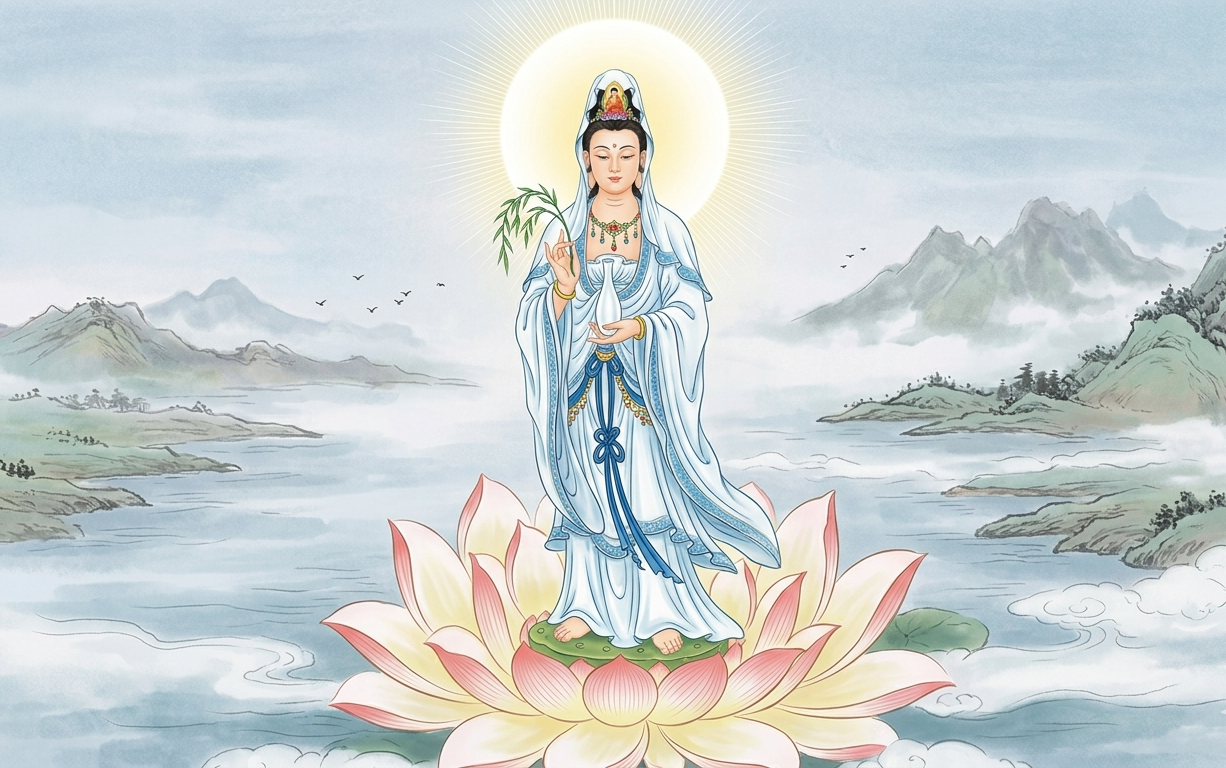
Guan Yin is particularly associated with mercy, healing, fertility, and protection of children. Mothers pray to her for safe births; the sick seek her healing presence; sailors on dangerous waters call her name for protection. She is depicted in many forms — seated on a lotus, standing on ocean waves, holding a willow branch and a vase of pure water, or nursing an infant — each image capturing a different dimension of her inexhaustible compassion.
In the great Chinese novel Journey to the West (西遊記), Guan Yin plays a pivotal role as the celestial guide who selects Xuanzang for his holy pilgrimage and who intervenes repeatedly to protect and assist the travelers. Her wisdom and compassion are the steady hand behind the journey's success — a reminder that spiritual progress is never without divine support.
The Guan Yin oracle lots (觀音籤) are among the most widely practiced forms of divination in the Chinese world. Devotees light incense, kneel before her image, hold their question sincerely in their hearts, and shake the bamboo cylinder of lots until one falls. The lot number corresponds to a classical poem, interpreted by the temple keeper to offer guidance on health, relationships, career, and life's turning points.
Guan Yin reminds us that compassion is not passive — it is active, responsive, endlessly present. She does not wait to be petitioned by the worthy; she turns toward every voice in need, without judgment and without condition. In a world that often demands strength through hardness, Guan Yin models a different kind of power: the power of a heart that stays open.
观音菩萨:听见世间哭声的慈悲之神
观音菩萨(觀世音菩薩),全名「观世音」,意为「观察世间一切声音者」,是中国、台湾、越南、韩国及全球华人社区中最受崇拜的神明之一,也是佛教与道教信仰中慈悲的最高象征。她的名字,是一个承诺:只要众生发出呼唤,她必然倾听,必然回应。
在佛教传统中,观音是阿弥陀佛座下的大菩萨,梵文名为「阿缚卢枳多伊湿伐罗(Avalokitesvara)」,意为「观自在」。她在证得圆满佛果之际,立下大愿:不入涅槃,誓度众生,直至世间一切苦难皆息。正是这份誓愿,令她成为无数人心中最贴近、最可依托的神明。
《妙法莲华经·观世音菩萨普门品》详述了她的神通:无论身陷火难、水难、刀难、牢狱之灾,只要至心称念「南无观世音菩萨」,她即刻显现,化解一切苦厄。她可以变化为三十三种形象——老人、孩童、医者、旅人——无论何种身份,最适合帮助眼前的苦难者,她便以何种形象出现。
中国流传最广的观音传说,是妙善公主的故事。妙善是某国王的第三女,她拒绝了父王安排的婚事,坚持出家修道,以慈悲普济为志。父王大怒,命人将她处死,然而她的灵魂不灭,入地狱后以诵经之力化解无数冤苦,后升香山修成正果。当父王重病垂危,妙善不计前嫌,献出自己的双眼与双手以救其命,父王幡然悔悟,成为她虔诚的信众。妙善,即成观音——以爱回报苦难的女儿,以牺牲诠释慈悲。
观音尤其与慈悲、治愈、护佑生育与儿童相关联。母亲们向她祈求平安分娩,病患向她祈求康复,海上行船的渔民向她祈求庇护。她的形象多样:或端坐莲台,或立于海浪之上,或手持杨枝净瓶,或怀抱婴孩——每一种形象,都是她无尽慈悲的不同面向。
在古典名著《西游记》中,观音菩萨是引领唐僧西行求法的神圣向导,多次在险境中出手相助,以智慧与慈悲护佑取经团队。她是整个旅程背后那双稳定而温柔的手——提醒我们:真正的灵性之路,从不是孤独的跋涉。
观音签是华人世界最普遍的求签传统之一。信众在观音像前燃香礼拜,将心中疑问诚心默念,摇动签筒,直至一支签落地,再依签号取签诗,由庙中解签者结合实际情境,为问者指点迷津。无论健康、感情、事业或人生抉择,观音签皆有指引。
观音菩萨告诉我们:慈悲不是软弱,而是一种更深的力量——在世界要求你坚硬时,依然保持一颗开放的心。南无观世音菩萨。
Explore Other Deities · 了解其他神明
To know more about other deities and decipher their oracle lots, visit: