Introduction
There is a saying among the old devotees of Guan Yin: She does not weigh your gifts. She weighs your heart. What follows is a parable passed down through generations of fishermen, merchants, and wanderers who came to her shores with nothing but need — and found, to their astonishment, that this was precisely enough.
商人的空手——观音菩萨接受心中的供奉
The Story
In the coastal town of Meiwan, there lived a merchant named Chen Bao who had, for thirty years, built a modest trade in silk and dried goods. He was not a rich man, but he had enough — enough to keep his family warm, enough to lay offerings of incense and fruit before the shrine of Guan Yin each spring festival.
That year, however, the sea brought no mercy.
A storm had swept through the harbour in the third month, and Chen Bao's entire cargo — three years of carefully gathered savings in the form of bolts of silk — had gone down with a borrowed junk. He owed debts he could not repay. His wife had fallen ill. His eldest son had departed for the city and not written in four months. Chen Bao was a man hollowed out by sorrow.
When the spring festival arrived, he walked to the temple with his neighbours, who carried baskets of oranges, sticks of incense bundled like sheaves of wheat, and paper offerings tied with red string. Chen Bao carried nothing.
At the entrance, he paused. He felt the familiar shame rise like a tide in his chest.
What do I have to offer her? he thought. Not even a stick of incense. Not even a handful of rice.
He nearly turned back. But something — some memory of his mother kneeling at this very threshold, murmuring that Guan Yin hears even silence — kept his feet moving forward.
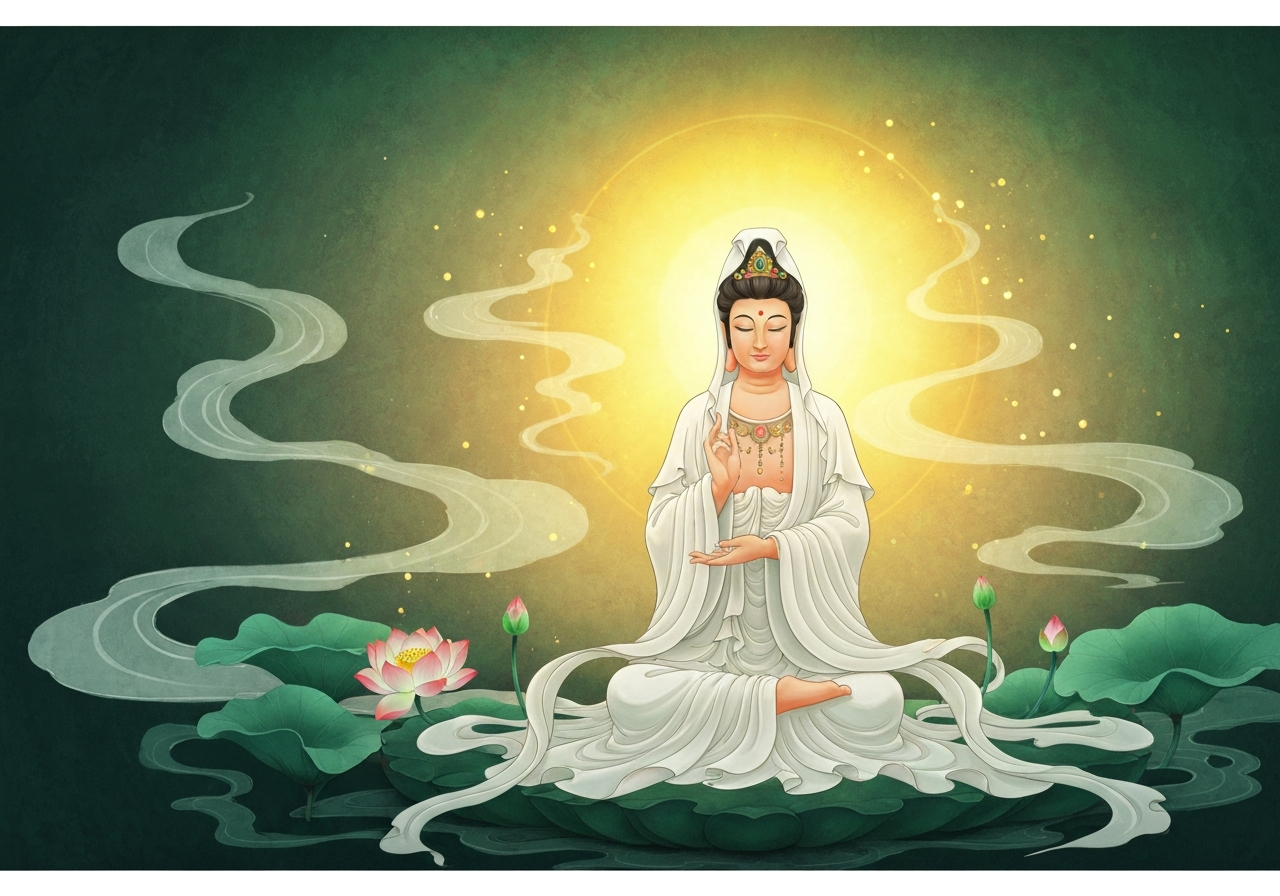
He entered the temple hall and stood before the great statue of the Bodhisattva. Her stone face was calm, her eyes half-closed as if in the midst of listening. One hand rested gently at her side. In the other, she held the willow branch and vase.
Around him, devotees placed their offerings with practised reverence. Oranges were stacked in pyramids. Incense smoke curled upward like a slow conversation with heaven.
Chen Bao had nothing to place on the altar.
He knelt anyway.
And then, unexpectedly, he began to weep.
Not the quiet weeping of dignity preserved, but the deep, shuddering sobs of a man who has held himself together for too long and finally admits he cannot. He did not speak prayers. He could not form words. He simply wept — his empty hands folded before him, his forehead pressed low — and offered to Guan Yin the only thing he had: the whole terrible truth of his grief.
He did not know how long he knelt there. When he finally raised his eyes, the temple was nearly empty. The candles burned low. The incense had thinned to wisps.
But something had changed in the air. Or perhaps something had changed in him.
He felt, impossibly, lighter. As though the burden of his humiliation — of coming with empty hands — had been quietly lifted from his shoulders and set aside. He realised with a start that he had been ashamed of his poverty, but not of his need. And that perhaps Guan Yin had never required the former, only welcomed the latter.
What Followed
On his walk home, Chen Bao passed the harbour master's house. The old man — a man Chen Bao had always greeted but never known well — called out from his gate.
"Chen Bao! I've been looking for you. I have a proposition. I need a trusted man to manage a cargo run north. The pay is fair. Are you free?"
It was not a miracle in the grand sense. No dragons descended. No lotus bloomed from the sea.
But Chen Bao took the work. And the work led to another. And by the end of the year, his debts were halved, his wife recovered, and his son wrote a long and apologetic letter from the city, asking if he might come home.
He returned to the temple the following spring with oranges and incense and good tea. But as he arranged his offerings before the serene stone face of Guan Yin, he remembered what he had learned.
She does not weigh the gifts. She weighs the heart.
He lit his incense. He bowed deeply. And in the quiet of the hall, he whispered his gratitude — not for the cargo runs or the recovered debts, but for that moment of grace when he had knelt with empty hands, and felt, for the first time, that he was received.
A Word for the Seeker
If you have come to Guan Yin today with nothing — no grand offering, no rehearsed prayer, no certainty that you deserve to be heard — know this: the empty hands are, in her teaching, always full. What you carry is your heart's truth. What she receives is always enough.
引言
老香客中流传着一句话:她不称量你的礼物,她称量你的心。以下这个故事代代流传于渔夫、商人与漂泊者之间。他们来到她的岸边,身无长物,只带着需求——却惊讶地发现,这已足够。
故事
在梅湾这座海滨小镇,住着一位名叫陈宝的商人。三十年来,他经营着一桩丝绸与干货的小买卖,不算富裕,却也够用——够让家人温暖,够在每年春节时在观音菩萨的神龛前供奉香火与果品。
然而那一年,大海毫无慈悲。
三月间的一场风暴席卷港口,陈宝满载三年积蓄、整批丝绸的租来货船随波沉没。他欠下还不清的债,妻子卧病在床,大儿子去城里已四个月未曾来信。陈宝是一个被悲苦掏空的人。
春节到来,他随邻里一同前往庙宇。邻人们提着满篓橙子、成捆的香,还有红线捆扎的纸供品。陈宝——两手空空。
在庙门口,他停住了脚步。那熟悉的羞耻感如潮水般涌上心头。
我有什么可以供奉她?他心想。连一根香都没有,连一把米都没有。
他几乎要转身离去。但某种力量——某段母亲在这同一道门槛前跪拜的记忆,母亲低声说观音菩萨连沉默都听得见——让他的脚步继续向前。
他走进大殿,站在菩萨的高大神像前。她的面容平静如石,眼睑微垂,仿佛正沉浸于倾听之中。一手安然垂于身侧,另一手持着杨柳枝与净瓶。
周围的香客熟练而虔诚地摆放供品:橙子叠成宝塔,香烟如缓缓升起的祈语盘旋而上。
陈宝没有任何东西可以放在供台上。
他还是跪了下来。
然后,出乎意料地,他哭了。
不是那种维持体面的轻声啜泣,而是一个撑持太久、终于承认力不从心的男人发出的深沉抽噎。他没有口诵祷词,连话语也组不成。他就这样哭泣着——空手交握,额头低低垂下——将他仅有的一样东西献给观音:他悲痛中全部赤裸的真实。
他不知道跪了多久。当他终于抬起眼睛,大殿里已几乎空无一人。烛火低垂,香烟散成缕缕轻雾。
但空气中有什么变了。或者说,是他内心有什么变了。
他感到,奇异地,轻盈了些。仿佛那重如山石的羞耻——空手而来的羞耻——已被悄悄从他肩头取走,放到了一旁。他猛然意识到:他曾为自己的贫穷而羞惭,却未曾为自己的需求而羞惭。而观音菩萨,也许从未要求前者,只是默默迎纳后者。
此后之事
回家途中,陈宝路过港务长的宅前。那老人——陈宝向来问候却并不熟识的人——从门口唤住了他。
"陈宝!我正在找你。我有个主意。我需要一个可靠的人帮我跑一趟北边的货运,酬劳公道。你有空吗?"
这不是那种宏大意义上的奇迹,没有神龙降临,没有莲花从海中绽放。
但陈宝接下了这份差事。这份差事引来了另一份。年底,他的债务少了一半,妻子康复了,儿子也从城里寄来了一封长信,满篇歉意,问能否回家。
翌年春节,他提着橙子、香和好茶回到庙中。在观音慈悲的石像前摆好供品时,他记起了他所学到的。
她不称量礼物,她称量心。
他点燃香,深深俯首。在大殿的宁静中,他轻声道谢——不是为了那些货运差事,也不是为了还清的债务,而是为了那一刻的恩典:当他跪拜时两手空空,却第一次感到,自己被接纳了。
寻道者的一句话
若你今日来到观音菩萨面前,两手空空——没有隆重的供奉,没有事先准备好的祷词,也没有自己值得被聆听的把握——请记住:在她的教化里,空手之人,心中从来都是满的。你所携带的,是你内心的真实。她所接纳的,永远已然足够。
Explore Other Deities · 了解其他神明
To know more about other deities and decipher their oracle lots, visit: